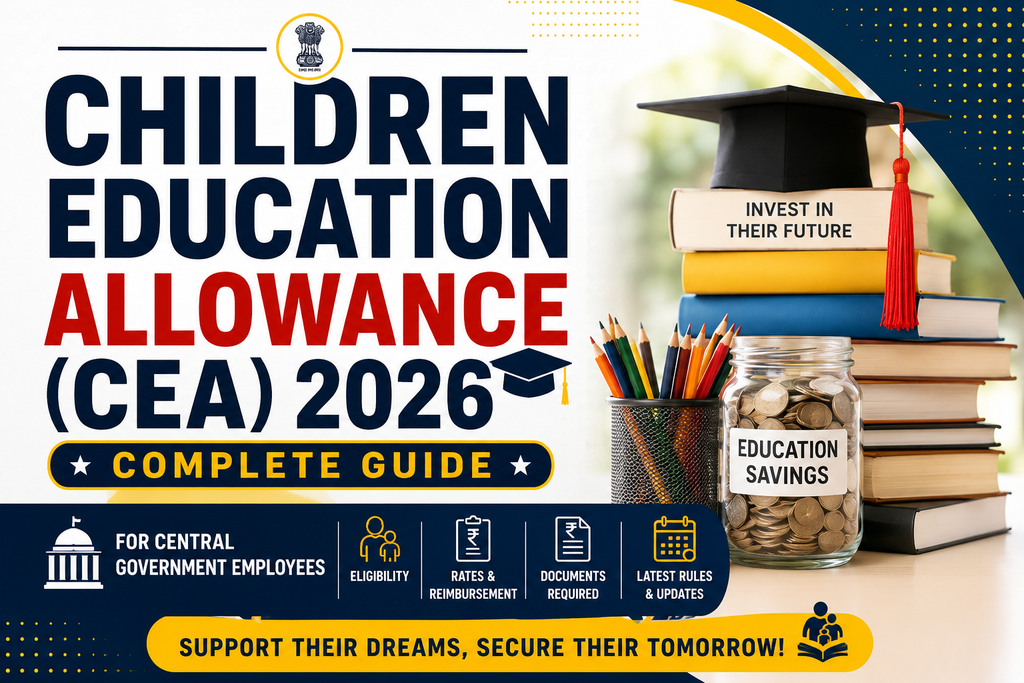
Children Education Allowance (CEA) 2026 – Complete Guide for Central Government Employees
The Children Education Allowance (CEA) is one of the most valuable welfare benefits available to Central Government employees. It helps reimburse a portion of the educational expenses incurred on school-going children and is available under the recommendations of the 7th Central Pay Commission (7th CPC).
Following the increase in Dearness Allowance (DA) to 50% with effect from 1 January 2024, the Department of Personnel and Training (DoPT) confirmed that the rates of Children Education Allowance (CEA) and Hostel Subsidy stand automatically enhanced by 25%, as provided under the original Office Memorandum dated 17 July 2018.
As a result, eligible Central Government employees can now claim higher reimbursement towards their children’s education, providing much-needed relief amid rising school fees and education-related expenses.
In this comprehensive guide, you’ll learn everything about Children Education Allowance 2026, including the revised rates, eligibility criteria, claim process, required documents, hostel subsidy, special provisions for Divyang children, and answers to the most frequently asked questions.
Quick Overview of Children Education Allowance (CEA)
| Particular | Details |
|---|---|
| Scheme Name | Children Education Allowance (CEA) |
| Governing Authority | Department of Personnel & Training (DoPT) |
| Applicable To | Central Government Employees |
| Based On | 7th Central Pay Commission |
| Latest Revision | 25% Increase |
| Effective Date | 1 January 2024 |
| Benefit | Reimbursement of Children’s Education Expenses |
| Hostel Subsidy | Available |
| Divyang Child Benefit | Enhanced |
What is Children Education Allowance (CEA)?
The Children Education Allowance (CEA) is a reimbursement scheme introduced by the Government of India to help Central Government employees meet the educational expenses of their children.
Instead of paying a fixed allowance every month, the Government reimburses eligible expenses up to the prescribed ceiling after the employee submits the required documents and claim.
The scheme aims to reduce the financial burden of school education and encourage quality education for the children of Government employees.
Why Were the CEA Rates Revised?
The recent increase in CEA is not a new scheme, but the implementation of an automatic revision clause already provided under the DoPT Office Memorandum dated 17 July 2018.
According to Paragraph 2(e) of the OM:
The rates of Children Education Allowance (CEA) and Hostel Subsidy shall automatically increase by 25% whenever Dearness Allowance (DA) reaches 50%.
Since DA reached 50% with effect from 1 January 2024, the revised rates became applicable automatically. The DoPT Office Memorandum dated 25 April 2024 clarified the revised monetary limits and removed any confusion regarding implementation.
Official Government Orders Behind the Revision
The revised rates are based on the following official Government instructions:
- Ministry of Finance Office Memorandum increasing Dearness Allowance to 50% from 1 January 2024.
- DoPT Office Memorandum dated 17 July 2018, which introduced the automatic 25% enhancement clause.
- DoPT Clarification Office Memorandum dated 25 April 2024, confirming the revised CEA and Hostel Subsidy limits.
These instructions ensure that employees receive enhanced reimbursement without waiting for a separate policy announcement each time DA reaches the prescribed threshold.
Who is Eligible for Children Education Allowance (CEA)?
The Children Education Allowance (CEA) is available to eligible Central Government employees to reimburse educational expenses incurred on their children’s schooling. The scheme is governed by the Department of Personnel and Training (DoPT) and applies to various categories of Government employees as per the prescribed rules.
Eligibility for Children Education Allowance
| Employee Category | Eligible |
|---|---|
| Central Government Employees | ✅ |
| Defence Civilian Employees | ✅ |
| Railway Employees | ✅ |
| Union Territory Employees (where applicable) | ✅ |
| Civilian Employees under Central Autonomous Bodies (if adopted) | As per Rules |
| State Government Employees | ❌ (Unless adopted by the respective State Government) |
The allowance is generally available to regular Central Government employees who meet the conditions laid down by the DoPT.
How Many Children are Eligible Under CEA?
The Children Education Allowance is normally admissible for up to two children.
However, certain exceptions are permitted under Government rules.
| Condition | Eligibility |
|---|---|
| First Child | ✅ Eligible |
| Second Child | ✅ Eligible |
| Twins born after the first child | ✅ Eligible |
| Divyang Child | Special provisions available |
| Adopted Child | Eligible as per DoPT rules |
Employees should refer to the latest DoPT instructions for special cases such as multiple births and adoption.
Revised Children Education Allowance (CEA) Rates 2026
After the Dearness Allowance reached 50%, the reimbursement ceilings increased automatically by 25%.
Revised CEA Rates
| Particular | Earlier Rate | Revised Rate |
|---|---|---|
| CEA per Month per Child | ₹2,250 | ₹2,812.50 |
| Annual Ceiling per Child | ₹27,000 | ₹33,750 |
The revised ceiling applies from 1 January 2024 and continues unless revised further under Government orders.
Hostel Subsidy Revised Rates
Employees whose children stay in recognised hostels attached to educational institutions can also claim Hostel Subsidy.
| Particular | Earlier Rate | Revised Rate |
|---|---|---|
| Hostel Subsidy (Monthly) | ₹6,750 | ₹8,437.50 |
| Annual Ceiling | ₹81,000 | ₹1,01,250 |
This increase also became effective from 1 January 2024.
Revised Benefits for Divyang Children
The Government provides additional financial support for Divyang (differently-abled) children under the CEA scheme.
| Particular | Earlier | Revised |
|---|---|---|
| Divyang Child CEA | ₹4,500/month | ₹5,625/month |
This enhanced reimbursement recognises the additional educational requirements of differently-abled children.
Special Allowance for Women Employees with Disabilities
The DoPT has also revised the Special Allowance for Child Care for Women with Disabilities.
| Particular | Earlier | Revised |
|---|---|---|
| Child Care Allowance | ₹3,000/month | ₹3,750/month |
The increase follows the same automatic enhancement mechanism triggered by the Dearness Allowance reaching 50%.
Effective Date of Revised Rates
The revised Children Education Allowance and Hostel Subsidy rates are applicable with effect from 1 January 2024.
Employees submitting reimbursement claims for the academic period beginning on or after this date should use the revised ceilings while preparing their claims.
If claims were submitted using the earlier limits, employees may contact their administrative office to determine whether revision or supplementary claims are permitted.
Old vs New CEA Rates – Comparison Table
| Allowance | Earlier | Revised |
|---|---|---|
| Children Education Allowance | ₹2,250/month | ₹2,812.50/month |
| Annual CEA Ceiling | ₹27,000 | ₹33,750 |
| Hostel Subsidy | ₹6,750/month | ₹8,437.50/month |
| Annual Hostel Ceiling | ₹81,000 | ₹1,01,250 |
| Divyang Child CEA | ₹4,500/month | ₹5,625/month |
| Child Care Allowance for Women with Disabilities | ₹3,000/month | ₹3,750/month |
Why is the Revision Important?
The enhancement provides meaningful financial relief to Central Government employees facing rising education costs.
Some key benefits include:
- Higher reimbursement for school fees and educational expenses.
- Increased hostel subsidy for children studying away from home.
- Additional support for families with Divyang children.
- Better financial assistance without introducing a new policy, as the revision is built into the existing DoPT framework.
Example of CEA Calculation
Understanding the revised limits becomes easier with practical examples.
Example 1: Two School-Going Children
| Particular | Amount |
|---|---|
| Maximum Annual CEA per Child | ₹33,750 |
| Number of Eligible Children | 2 |
| Total Annual Reimbursement | ₹67,500 |
Example 2: One Child Staying in a Hostel
| Particular | Amount |
|---|---|
| Annual Hostel Subsidy Ceiling | ₹1,01,250 |
The actual reimbursement is subject to eligibility, admissible expenses, and submission of the required documents.
Excellent. Here’s Part 3 of your premium SEO pillar article on Children Education Allowance (CEA).
How to Claim Children Education Allowance (CEA)?
The Children Education Allowance (CEA) is a reimbursement-based benefit. Eligible Central Government employees can claim reimbursement after paying their child’s educational expenses and submitting the prescribed documents to their department.
The claim process has been simplified over the years, making it easier for employees to receive reimbursement.
Step-by-Step CEA Claim Process
Follow these steps to claim Children Education Allowance successfully.
Step 1: Pay the School Fees
Pay the eligible educational expenses for your child during the academic year.
Step 2: Collect Supporting Documents
Keep all necessary documents safely, including fee receipts and school certificates.
Step 3: Fill the CEA Claim Form
Complete the prescribed Children Education Allowance Claim Form issued by your department.
Step 4: Attach Required Documents
Attach supporting documents along with the claim form.
Step 5: Submit Online
Submit the completed claim to online to the https://www.ksb.gov.in/ :
Step 6: Verification
Your department verifies:
- Employee eligibility
- Child eligibility
- School recognition
- Supporting documents
Step 7: Reimbursement
After successful verification, the admissible amount is credited through salary or departmental reimbursement.
Documents Required for CEA Claim
Employees should keep the following documents ready while submitting their claim.
| Document | Required |
|---|---|
| Filled CEA Claim Form | ✅ |
| Original School Fee Receipt | ✅ |
| Self Declaration | ✅ |
| Bonafide Certificate (if required) | ✅ |
| Report Card/Progress Report (where applicable) | Recommended |
| Hostel Certificate (for Hostel Subsidy) | If Applicable |
| Disability Certificate (for Divyang Child) | If Applicable |
Maintaining complete documentation helps avoid delays in claim settlement.
Educational Institutions Covered
Children Education Allowance is generally admissible for studies in recognised educational institutions.
Eligible institutions include:
- Government Schools
- Kendriya Vidyalayas (KVs)
- Jawahar Navodaya Vidyalayas
- State Government Schools
- Government-Aided Schools
- CBSE Schools
- ICSE Schools
- State Board Schools
- Recognised Private Schools
The institution should be recognised by the appropriate education authority.
Expenses Covered Under Children Education Allowance
The allowance is intended to reimburse eligible educational expenses up to the prescribed ceiling.
Depending on applicable rules, eligible expenses may include:
- Tuition Fees
- Admission Fees
- Laboratory Fees
- Library Fees
- Examination Fees
- Computer Fees
- Smart Class Charges
- Games & Sports Fees (where admissible)
- Annual Charges
Employees should always verify the latest DoPT guidelines applicable to their department before submitting claims.
Expenses Not Normally Covered
Certain personal or optional expenses are generally not reimbursable under the CEA scheme.
Examples include:
- School Uniform
- Shoes
- School Bag
- Personal Stationery
- Transportation Charges (unless specifically admissible)
- Private Coaching Fees
- Personal Books purchased separately
- Optional Activities not covered under the school fee structure
Common Reasons for Rejection of CEA Claims
Many reimbursement claims are delayed or rejected due to avoidable mistakes.
Some common reasons include:
Missing Documents
Incomplete documentation is one of the biggest reasons for rejection.
Incorrect Claim Form
Using an outdated or incomplete claim form can delay processing.
Missing Fee Receipts
Original fee receipts or proper proof of payment may be required.
Claim Beyond Permissible Limit
Employees cannot claim beyond the prescribed reimbursement ceiling.
Unrecognised School
The educational institution must meet the eligibility conditions under Government rules.
Delayed Submission
Late submission may result in delayed reimbursement or rejection as per departmental procedures.
Tips for Faster Claim Processing
To ensure quick settlement of your Children Education Allowance claim:
- Keep original fee receipts safely.
- Submit claims within the prescribed timeline.
- Verify that all documents are attached.
- Fill the claim form carefully.
- Maintain copies of all submitted documents.
- Follow up with your administrative office if required.
Benefits of Children Education Allowance
The CEA scheme offers significant financial assistance to Central Government employees.
Major Benefits
- Helps reduce the burden of school fees.
- Supports quality education for children.
- Provides Hostel Subsidy for eligible students.
- Offers enhanced reimbursement for Divyang children.
- Automatically increases whenever Dearness Allowance reaches the prescribed threshold under Government rules.
- Improves financial security for Government employees with school-going children.
Why the 25% Increase Matters
Education costs have risen considerably in recent years due to higher tuition fees, digital learning requirements, books, laboratory charges, and hostel expenses.
The automatic enhancement linked to Dearness Allowance ensures that the reimbursement limits remain more aligned with inflation and the increasing cost of education, providing meaningful support to Central Government employees.
Frequently Asked Questions (FAQs)
1. What is Children Education Allowance (CEA)?
Children Education Allowance is a reimbursement scheme provided to eligible Central Government employees to help cover their children’s educational expenses.
2. Who can claim Children Education Allowance?
Eligible Central Government employees, including Defence civilian employees and certain other categories covered under DoPT rules, can claim CEA.
3. How many children are covered under CEA?
Normally, reimbursement is admissible for up to two children, subject to applicable exceptions such as twins born after the first child.
4. What is the revised CEA amount?
The revised reimbursement ceiling is ₹2,812.50 per month per child, with an annual limit of ₹33,750 per child.
5. What is the revised Hostel Subsidy?
The revised Hostel Subsidy is ₹8,437.50 per month, subject to an annual ceiling of ₹1,01,250.
6. From when are the revised rates applicable?
The revised rates are effective from 1 January 2024.
7. Is the increase automatic?
Yes. The increase is automatic as per the DoPT Office Memorandum dated 17 July 2018, once Dearness Allowance reaches 50%.
8. Are separate Government orders required every time?
No. The enhancement is automatic under the existing rules, although DoPT may issue clarifications to confirm the revised monetary limits.
9. Can both husband and wife claim CEA for the same child?
No. Generally, only one eligible parent can claim Children Education Allowance for a particular child.
10. Is Children Education Allowance available for college education?
CEA is primarily intended for school education as per applicable Government rules. Employees should refer to the latest DoPT guidelines for specific eligibility conditions.
Final Verdict
The Children Education Allowance (CEA) is one of the most important welfare benefits available to Central Government employees. With the automatic 25% enhancement triggered by Dearness Allowance reaching 50%, employees can now claim higher reimbursement for school education and hostel expenses, helping them manage rising education costs more effectively.
To ensure a smooth claim process, employees should stay updated with the latest DoPT guidelines, retain all supporting documents, and submit claims within the prescribed timelines. By understanding the eligibility conditions, reimbursement limits, and claim procedure, beneficiaries can make full use of this valuable Government scheme.
📞 Need Financial or Tax Assistance?
At FaujiFinanceBazaar.com, we help Defence Personnel, Central Government Employees, and Veterans with:
- 🏠 Home Loans
- 🚗 Car Loans
- 🏍️ Bike Loans
- 💳 Credit Cards
- 📈 Mutual Funds & SIP
- 🛡️ Health & Life Insurance
- 📄 Income Tax Return (ITR) Filing
- 💼 Financial Planning
📱 WhatsApp: 8587920916
🌐 FaujiFinanceBazaar.com