
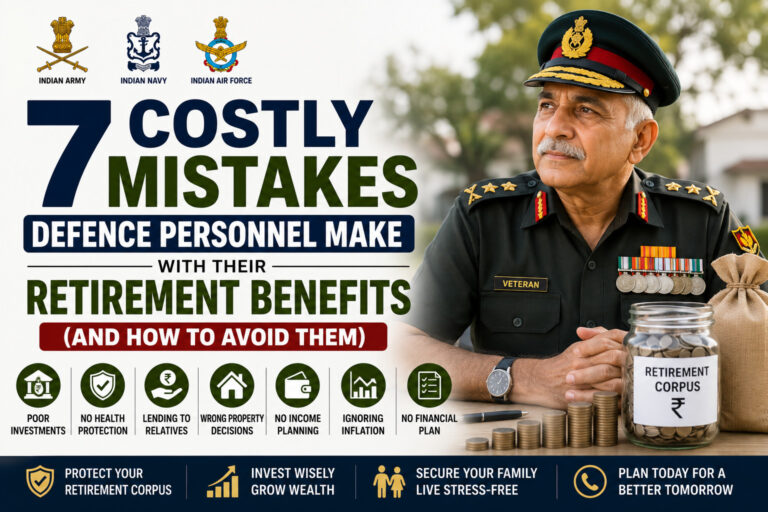
7 Costly Mistakes Defence Personnel Make With Their Retirement Benefits (And How to Avoid Them)
Introduction
After serving the nation for 15, 20, or even 30 years, Defence Personnel receive retirement benefits that often represent the largest amount of money they have ever accumulated at one time.
Depending on rank, length of service, gratuity, leave encashment, commutation, AGIF benefits, and other payouts, many Ex-Servicemen retire with ₹20 lakh to ₹60 lakh or more.
Unfortunately, a significant number of veterans make financial decisions in the first few years after retirement that negatively impact their long-term financial security.
This article discusses the most common retirement mistakes Defence Personnel make and how to protect your retirement corpus.
Mistake #1: Investing the Entire Retirement Corpus in Fixed Deposits
Many veterans feel that Fixed Deposits are the safest investment option.
While FDs provide safety, they may not generate returns sufficient to beat inflation.
Example
If inflation averages 6% and your FD generates 6.5% before tax, your real wealth growth may be very limited.
Better Approach
Create a balanced portfolio consisting of:
- Emergency Fund
- Fixed Income Investments
- Mutual Funds
- Health Insurance
- Liquid Funds
Diversification is essential.
Mistake #2: Buying Expensive Traditional Insurance Policies
One of the most common mistakes is purchasing insurance products marketed as investments.
Many retirees invest large amounts in:
- Endowment Plans
- Money Back Plans
- Traditional Insurance Schemes
These products often provide lower long-term returns compared to other investment options.
Better Approach
Separate:
- Insurance
- Investments
Use term insurance (if required) and invest separately for growth.
Mistake #3: Lending Money to Relatives and Friends
After retirement, relatives and acquaintances often approach veterans for financial assistance.
Common requests include:
- Business funding
- Personal loans
- Property investments
Many veterans lend substantial amounts and later struggle to recover the money.
Better Approach
Protect your retirement corpus.
Only lend money that you can afford to lose.
Mistake #4: Buying Property Without Proper Research
Many Defence Personnel invest their retirement benefits in:
- Plots
- Under-construction projects
- Farmland
- Commercial property
Without proper due diligence, these investments can become illiquid or problematic.
Before Buying Property
Verify:
- Ownership records
- Approvals
- Location potential
- Legal status
- Resale demand
Never invest solely based on verbal promises.
Mistake #5: Ignoring Health Insurance
Many veterans rely entirely on ECHS.
While ECHS is a valuable benefit, additional health coverage may provide:
- Faster treatment options
- Wider hospital access
- Better family protection
Medical inflation continues to rise every year.
A health emergency can significantly impact retirement savings.
Mistake #6: Keeping All Money in Savings Accounts
Some retirees keep large amounts in savings accounts because they fear investment risk.
The problem:
Inflation steadily reduces purchasing power.
Example
₹40 lakh today will not have the same purchasing power 15 years later.
Money must work for you.
Mistake #7: Not Creating a Retirement Income Plan
Retirement is not just about receiving a lump sum.
It is about generating sustainable income for decades.
Many veterans focus only on preserving capital and ignore income planning.
A Better Strategy
Combine:
- Pension Income
- Fixed Income Investments
- Monthly Income Schemes
- Mutual Funds
- Emergency Reserves
This creates both stability and growth.
What Should Defence Personnel Do Instead?
A retirement corpus should generally serve five purposes:
1. Emergency Fund
For unforeseen expenses.
2. Monthly Income
To supplement pension.
3. Long-Term Growth
To beat inflation.
4. Healthcare Protection
For family security.
5. Future Goals
Children’s education, marriage, home improvement, travel, etc.
Retirement Planning Checklist for Veterans
Before investing retirement benefits:
✔ Create a written financial plan
✔ Maintain emergency reserves
✔ Review health insurance needs
✔ Diversify investments
✔ Avoid unverified schemes
✔ Consider tax implications
✔ Seek professional advice when required
Frequently Asked Questions
Should I invest all retirement money in FDs?
No. A balanced investment approach generally provides better protection against inflation.
Is ECHS enough after retirement?
ECHS is extremely valuable, but additional health insurance may be beneficial for some families.
Should I invest in mutual funds after retirement?
Depending on risk tolerance, mutual funds can help maintain purchasing power and support long-term financial goals.
How much emergency fund should a veteran maintain?
Generally, at least 6–12 months of expenses should remain easily accessible.
Is property the best retirement investment?
Not always. Every investment decision should be based on financial goals, liquidity needs, and risk tolerance.
Conclusion
Retirement benefits are not merely a payout—they are the financial reward for decades of dedicated service to the nation.
The decisions made during the first few years after retirement can significantly influence financial security for the rest of your life.
By avoiding common mistakes and following a structured financial plan, Defence Personnel can create a retirement that is financially secure, independent, and stress-free.
Protect your retirement corpus, invest wisely, and make every rupee work for your future.
Need Retirement Planning Assistance?
FaujiFinanceBazaar.com
We help Defence Personnel and Ex-Servicemen with:
✔ Retirement Planning
✔ Mutual Funds & SIPs
✔ Tax Planning
✔ Health Insurance
✔ Home Loans
✔ Financial Goal Planning
📞 WhatsApp: 8587920916
FaujiFinanceBazaar.com
Your Trusted Financial Partner for Defence Personnel & Ex-Servicemen